
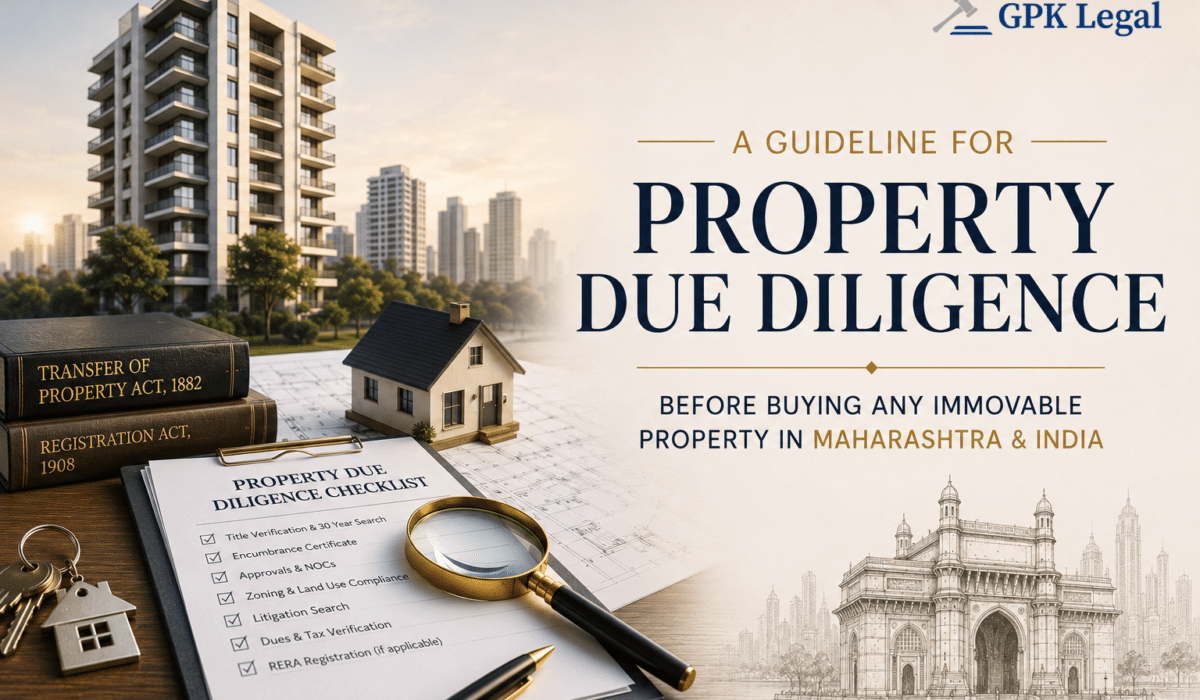
Guidelines Property Due Diligence
A Guideline for Property Due Diligence Before Buying any Immovable Property in Maharashtra and India
This blog is written from layman’s point of view to make aware homebuyers in Maharashtra and India and is not a solicitation or advertisement for legal services. It has drafted to help a common reader understand what “property due diligence” actually means before buying any immovable property, especially in and around Pune and other cities in Maharashtra.
Why lawyers write educational guides (and not ads)
In India, advocates are expressly prohibited from advertising or soliciting work, directly or indirectly, under Rule 36 of the Bar Council of India Rules framed under the Advocates Act, 1961. Recent Bar Council of India statements have clarified that this ban extends to digital platforms, social media promotions, celebrity endorsements and SEO‑driven marketing campaigns.
At the same time, the Bar Council recognises that general legal education for the public is permissible, as long as it does not amount to direct or indirect client solicitation. This article follows that approach: it offers a structured, Maharashtra‑focused property due diligence checklist, but does not make any comparative claims, guarantees, or calls to “hire” a particular lawyer or firm.
What is property due diligence?
“Property due diligence” is the legal and factual investigation of the status of the property a buyer conducts before entering into any agreement in respect with immovable property for a flat, plot or building, to ensure that:
- The seller has a clear and marketable title and the legal right to sell.
- The property complies with zoning and construction laws and has necessary approvals.
- There are no hidden mortgages, disputes, regulatory violations or unpaid dues.
- The property is not within any hindrance, legal impediment and transferable as per surviving laws.
Authoritative guides on real estate transactions in India consistently emphasise examination of the title chain, encumbrance records, government approvals and litigation risks for at least 30 years before purchase. For Maharashtra cities like Mumbai, Pune and Nagpur, this includes additional checks in state‑specific records such as property cards, 7/12 extracts, mutation entries and Maharashtra Real Estate Regulatory Authority (MahaRERA) registration.
Reason for investigation of title for last 30 years: After verifying that the vendor had legal right to dispose of the property under investigation another step to be taken is to ascertain whether the vendor had a legal title in the property traceable in the chain of title for thirty years. Many of them prefer to make title searches only for Ten- Fifteen- Twenty years period as the limitation period for action for claiming relief against adverse possession is twelve Years and searches beyond that are ignored. But it is essential to have a search for thirty years period. The logic behind 30 years report is that the minor requires eighteen years when he attains the age of majority and thereafter, he can claim his share within twelve years of attaining majority.
Thus, the basic idea behind such search emanates from the fact that the seller has to deliver “Marketable Title” to the property proposed to be sold to the purchaser which means title should be free from reasonable doubts as to its validity. In case any defect as to the validity to title appears at the time of investigation of title, the seller has to correct it. Legal framework for buyers in Maharashtra.
When you buy a flat or land parcel in Maharashtra, multiple central and state laws operate together. Among the key legal instruments and regulators are:
- Real Estate (Regulation and Development) Act, 2016 (RERA) and MahaRERA for registered projects and promoters.
- Transfer of Property Act, 1882 and Registration Act, 1908 for sale deeds and transfer formalities.
- Maharashtra Regional and Town Planning (MRTP) framework and local development plans for zoning and land use permissions.
- Maharashtra Apartment Ownership Act and Maharashtra Cooperative Societies Act for apartment ownership, societies and common areas in multi‑storey buildings.
Any complete legal guide to property purchase in Mumbai or Pune emphasises that a safe transaction depends on both document verification and compliance with these regulatory frameworks.
- Step 1: Clarify what exactly you are buying
Before asking for documents, you should be clear about the nature of the asset:
- Is it a flat /apartment /unit in a registered housing society, an apartment association, or still an under-construction project with the Developer?
- Is it freehold land, leasehold land, or land given under a development agreement or joint development, plot comes under MIDC?
- Is it agricultural land that has been converted, or is proposed to be converted, for residential or commercial use?
Guides on real estate due diligence in Maharashtra recommend confirming whether the title is freehold or leasehold, and reviewing any development agreement or power of attorney under which the seller claims rights to sell. This directly affects your long‑term usage rights, ability to mortgage, and resale prospects.
- Step 2: Title deed and 30‑year ownership chain
Title verification is the backbone of property due diligence. As a buyer, insist on:
- The current title deed (sale deed, conveyance deed, gift or partition deed) in favour of the seller, duly stamped and registered.
- A continuous chain of title documents for at least 30 years, showing how ownership moved from one party to another. The reason of 30 years described above in detail.
- Where documents older than 30 years are unavailable, at least 15 years of clear title is usually expected, supported by possession and revenue records.
Well‑regarded legal checklists for homebuyers in India stress that no person can convey better title than what they themselves hold, and missing links in the chain are a red flag for litigation or defective title. For investors in Maharashtra, professional title search reports by advocates often consolidate these 30‑year records into one opinion.
- Step 3: Check land records – 7/12 extract, property card and mutation
For land and many older properties in Maharashtra, you must cross‑verify ownership in government land records:
- 7/12 extract (Saat‑Baara Utara) and related revenue records show details of the land, owners, area and certain encumbrances in rural and semi‑urban Maharashtra.
- Property card and city survey (CTS) records display urban land boundaries, survey numbers and recorded ownership in cities and towns.
- Mutation entries (ferfar) demonstrate that ownership changes reflected in sale deeds have been updated in revenue records.
Expert due diligence guides for Mumbai and Nagpur emphasise matching the seller’s name and survey details across title deeds, 7/12 extracts, property cards and mutation records, as inconsistencies can indicate incomplete transfers or pending issues. This step is critical when buying open plots around Pune, PCMC or other expanding urban areas.
- Step 4: Encumbrance certificate and court litigation search
Even a seemingly clear title can be affected by loans, mortgages, court orders or family disputes. To address this risk:
- Obtain an Encumbrance Certificate (EC) from the sub‑registrar’s office for the relevant period (typically 12–30 years).
- A clean EC shows there are no registered mortgages, charges, sale agreements or court‑attached encumbrances on the property.
- Conduct a litigation search at local courts or online databases for cases involving the property, survey number, building name, or seller.
Practical due diligence checklists for buyers in Mumbai and other cities advise treating properties with active litigation, injunctions or government acquisition notices as high‑risk, unless your advocate clearly explains and accepts the risks in writing.
- Step 5: Zoning, land use and NA (non‑agricultural) status
Land use and zoning compliance are especially important if you are buying a plot or a standalone building.
- Confirm that the land is legally permitted for the proposed use (residential, commercial, industrial) as per the local development plan and zoning regulations.
- For agricultural land, check whether non‑agricultural (NA) conversion orders and related permissions are in place for residential or commercial use.
- Verify any reservations or restrictions under the local master plan that may affect construction, road widening, public utilities or future redevelopment.
Maharashtra‑focused guides highlight that failure to follow zoning and NA rules can lead to demolition notices, penalties, or inability to obtain completion and occupancy certificates. This makes early land use verification a non‑negotiable part of legal due diligence before buying a plot in or around Pune, Nagpur or Mumbai.
- Step 6: Building plans, CC, OC and other approvals
For a flat or apartment in a constructed building, your lawyer will typically ask for copies of key municipal and regulatory approvals:
- Sanctioned building plans and layout approvals issued by the local municipal corporation or planning authority.
- Commencement Certificate (CC) permitting the builder to start construction as per sanctioned plans.
- Occupation Certificate (OC) confirming that the building is completed as per approvals and is fit for occupancy.
- NOCs and clearances where applicable (fire department, environment, water and electricity board, sewage and other utilities).
Homebuyer guides for Mumbai show that missing or irregular approvals can cause serious problems: banks may refuse home loans, and authorities can impose hefty penalties or even order demolition of unauthorised structures. For buyers in Pune, similar principles apply under the jurisdiction of local bodies like PMC, PCMC or PMRDA, even though the specific office names differ.
- Step 7: MahaRERA checks for under‑construction projects
If you are buying in an under‑construction project, RERA and MahaRERA are central to your property due diligence.
- Builders must register eligible projects with their state RERA before advertising, marketing or selling units beyond prescribed thresholds.
- Buyers in Maharashtra can verify project and promoter details on the official MahaRERA website using the RERA registration number displayed on marketing materials.
- MahaRERA disclosures include sanctioned plans, approvals, proposed completion timelines, and status of construction and financial details, improving transparency and accountability.
RERA guidelines emphasise that unregistered projects cannot be advertised or sold, and that buyers should verify carpet area, timelines and permissions directly via the RERA portal rather than relying only on brochures. Practical home‑buying articles routinely recommend MahaRERA verification as a mandatory step before booking a flat in Pune, Mumbai or any other city in the state.
- Step 8: Society documents and common area rights
For resale flats or newly formed societies, your due diligence should extend beyond the individual unit:
- If the building has a co‑operative housing society, confirm its registration certificate, bye‑laws and governing body details.
- Verify that the seller’s share certificate, maintenance payments and other dues to the society are clear and up to date.
- Check whether the society or association has passed resolutions regarding redevelopment, changes in FSI, or disputes that may affect your future rights.
Guides for Mumbai homebuyers note that incomplete society formation or unclear common area rights can create long‑term conflicts, especially in older or redeveloped buildings. This is equally relevant in Pune and other Maharashtra cities, where redevelopment and increased FSI have led to complex arrangements between landowners, developers and existing flat owners.
- Step 9: Taxes, utility dues and financial risks
Legal due diligence is not complete without basic financial and compliance checks:
- Confirm property tax receipts, water bills, electricity bills and maintenance charges are fully paid up to date; unpaid dues may otherwise pass to the new owner.
- Review any home loan or mortgage on the property and ensure it will be cleared or properly transferred at the time of sale.
- Understand your own stamp duty and registration charges and ensure the agreement correctly records consideration, carpet area and other mandatory disclosures.
Property due diligence guides stress that hidden financial liabilities—such as accumulated society dues, property tax arrears or undisclosed mortgages—are a common source of post‑purchase disputes and should be explicitly addressed in the sale documents.
- Step 10: Special scenarios – redevelopment, joint development and investor purchases
Certain transaction types need extra caution:
- Redevelopment projects often involve multiple overlapping rights between landowners, tenants and developers; diligent buyers seek clear agreements, consents and MahaRERA registration before investing.
- Joint development agreements (JDA) and powers of attorney must be carefully reviewed to confirm that the person signing the sale deed actually has authority to sell your particular unit or share.
- Investor‑grade due diligence for large purchases typically includes a comprehensive title search report, detailed technical and structural inspection, and verification of 10–12 key documents such as sale deed, 7/12 extract, property card, sanctioned plans, CC, OC, encumbrance certificate and RERA registration.
Professional checklists for serious investors in Mumbai and other Maharashtra cities describe these “extreme due diligence” document packs as standard expectations before funding or completing high‑value real estate deals.
Common red flags that should slow you down
While each case is unique, guides aimed at homebuyers repeatedly highlight certain warning signs:
- Breaks in the title chain, missing documents or inconsistent names across deeds and land records.
- Properties without sanctioned plans, CC or OC, or with significant deviations from approved plans.
- Projects not registered with MahaRERA despite meeting the registration thresholds.
- Active or past litigation involving the building, survey number, society or seller that has not been transparently disclosed.
Where one or more of these red flags are present, responsible guides strongly recommend detailed legal advice before paying token amounts, agreement advances or full consideration.
Practical buyer checklist (Maharashtra)
For a practical, Maharashtra‑focused legal checklist before buying a flat or plot in Pune or elsewhere in the state, most expert articles converge on the following minimum documents and checks:
- Latest title deed in seller’s name, plus 30 years’ title chain.
- 7/12 extract or property card, survey/CTS plan and mutation entries.
- Encumbrance Certificate for the relevant period.
- Sanctioned building plans, layout approvals, CC and OC (for buildings).
- MahaRERA registration details and disclosures (for eligible under‑construction projects).
- Society registration certificate, share certificate, maintenance and other dues status (for society flats).
- Clear disclosure of any existing loans, mortgages or disputes.
- Immovable property whether subject to acquisition by the government.
This list is not exhaustive and does not replace a detailed, case‑specific review by a qualified property lawyer familiar with Maharashtra laws and local authorities.
Disclaimer
This article is a general, Maharashtra‑focused overview of property due diligence and is not legal advice or a substitute for personalised consultation with an advocate. For any specific transaction, readers should seek independent advice from a qualified property lawyer before making financial commitments.